
Lawrence Wood Flooring takes on hardwood stair refinishing in Lawrence, MA, serving surrounding cities including Methuen, Andover, Haverhill, Lowell, Boxford. Over 20+ years we have refinished worn oak staircases, stripped painted stairs back to wood and converted carpeted steps to hardwood treads and risers.
A staircase gets more wear for its size than any floor in the house. Every step lands on the same front edge, the nosing wears through first, and in older homes the stairs may have been painted, carpeted or patched more than once. Refinishing them well takes slow, careful work on each step, which is why we quote stairs tread by tread rather than by the square foot.
We also plan around the fact that the stairs are usually the only way between floors. Whether you live in a single-family house or the upper unit of a two-family, the work is scheduled so you can still get up and down while the finish cures.
What Stair Refinishing Includes
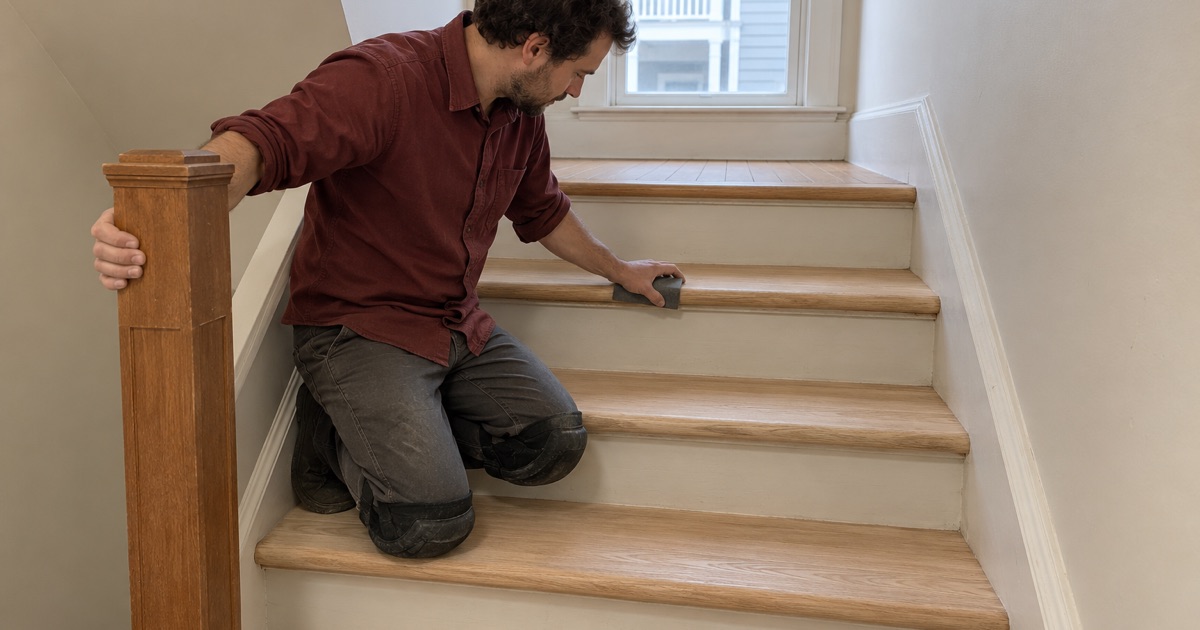
Treads
Treads are the part you walk on, and they show wear in a band along the front edge and down the center. We sand each tread with smaller sanders and by hand, working into the corners where the tread meets the stringer and the riser.
Deep gouges, cracks or loose treads are repaired or replaced before sanding. A tread that is split across the grain is a safety problem, not just a cosmetic one, and we treat it that way.
Risers
Risers are the vertical faces between treads. In many older homes they were painted while the treads were left natural or carpeted, and we either refinish them to match the treads or repaint them for contrast, depending on what you prefer.
Where the risers are a different, lower-grade wood than the treads, painting them is often the cleaner result. We tell you what is underneath before you decide.
Stair Nosing
The nosing is the rounded front edge of each tread, and it takes the hardest wear on the staircase. Its profile has to be sanded by hand to keep the shape, because a power sander flattens it. Worn or chipped nosing can be repaired, and where the nosing has been rounded down badly, a new piece or a retread may be the better fix.
Landings, Handrails and Balusters
Landings are refinished with the stairs so the color matches top to bottom. Handrails, newel posts and balusters can be included as well, quoted as separate lines so you can decide what to take on now.
The railing is touched by every hand that climbs the stairs, and its finish wears through to gray where people grip it. Sanding and refinishing the rail with the treads ties the whole staircase together.
Older and Painted Staircases
Stripping Painted Stairs
Many older stairs were painted at some point, sometimes several times. Stripping that paint is slow work, and in homes built before 1978 it has to be planned with Massachusetts lead-safe renovation rules in mind.
We confirm the build year and look at the paint before quoting, so the method and the setup are decided before any paint is disturbed. We also tell you honestly if the wood under the paint is a mix of species or full of old repairs, because that affects whether a natural finish is realistic.
Carpeted Stairs Turned Back to Wood
Under carpet, stairs often have rough treads that were never meant to be finished, along with tack strip, staples and pad residue. Sometimes the treads are good oak that just needs sanding; other times they are a lower-grade wood that was always meant to be covered.
We pull the carpet, pad and fasteners, look at what is there and give you options: refinish the existing treads, fit new hardwood treads and risers, or retread over the existing steps.
Retreads and New Treads
A retread is a new hardwood tread fitted over or in place of an existing one, often with a new riser to match. It is the usual fix when the original treads are too damaged to refinish or were never finish-grade wood.
New treads are cut to fit each step, because older staircases are rarely perfectly even from top to bottom. The finished stairs are then stained and coated to match the floors at the top and bottom.
Squeaky and Loose Steps
A squeaking step is usually a tread moving against a riser, a stringer or a loose nail. We refasten from below where the underside is open, or from above with fasteners that are set and filled where it is closed. We deal with squeaks before sanding, since the finish should go onto a staircase that is already solid.
Old Pine and Mixed-Wood Staircases
Back stairs and attic stairs in older houses were often built from pine or other softwood, while the front stairs got oak. Softwood treads dent and wear into hollows, and they sand away quickly under a heavy hand.
We sand pine stairs lightly, keep as much of the original wood as possible and tell you up front that worn hollows in the center of each step are part of the wood’s age. Where a tread has worn too thin to be safe, it is replaced rather than sanded thinner.
Stairs That Lean, Sag or Pull Away From the Wall
A staircase that has dropped at one side, a stringer pulling away from the wall or treads that flex underfoot point to a framing problem. We note what we see and refer structural work to a carpenter before refinishing, because a new finish on a failing staircase only hides a hazard.
Color, Finish and Matching the Floors
Matching the Hallway and Landings
Stairs almost always meet a hallway floor at the top and bottom, and the color needs to match both. When the floors are being refinished at the same time, the stairs get the same stain and finish so they read as one surface. When only the stairs are being done, we lay stain samples on a tread next to the existing floor so you can see how they compare before choosing.
Finish for Heavy Traffic
Stairs wear fastest at the nosing and in the center of each tread. We usually recommend a durable polyurethane in a satin or matte sheen, which hides scuffs better than gloss and holds up to the concentrated wear.
Waterborne finishes cure faster and keep odor down, which helps when the stairs cannot be closed off for long. Oil-modified finishes give oak a warmer tone, and we show you both before you choose.
Keeping the Stairs Usable
In a house with only one staircase, we can finish alternating treads so there is always a step to use, or time the coats so the finish has overnight to cure. In a two-family with a shared stairway, we coordinate with both households so nobody is cut off from their unit.
Stairs in Rentals and Multi-Family Houses
Shared Stairways
Shared front and back stairways in two- and three-family houses take traffic from every unit, plus moving day twice a year. Refinishing them with a tough finish and fixing loose or cracked treads keeps them safe for tenants and owners alike.
Between Tenancies
A unit’s interior stairs can be refinished along with the floors between tenants, scheduled around the move-out and move-in dates. The written estimate lists the stairs step by step, separate from the floors, so a landlord can see what each part costs.
Where a tenant has damaged a tread beyond ordinary wear, such as deep gouges from moving furniture or pet damage, we note that separately on the estimate. That itemized record is what a landlord needs before charging a tenant for floor damage.
- 20+ Years on Wood Floors
- Itemized Written Estimates
- Old Pine and Oak Work